August 21, 2026
What Is a Needle Felted Pet Portrait?
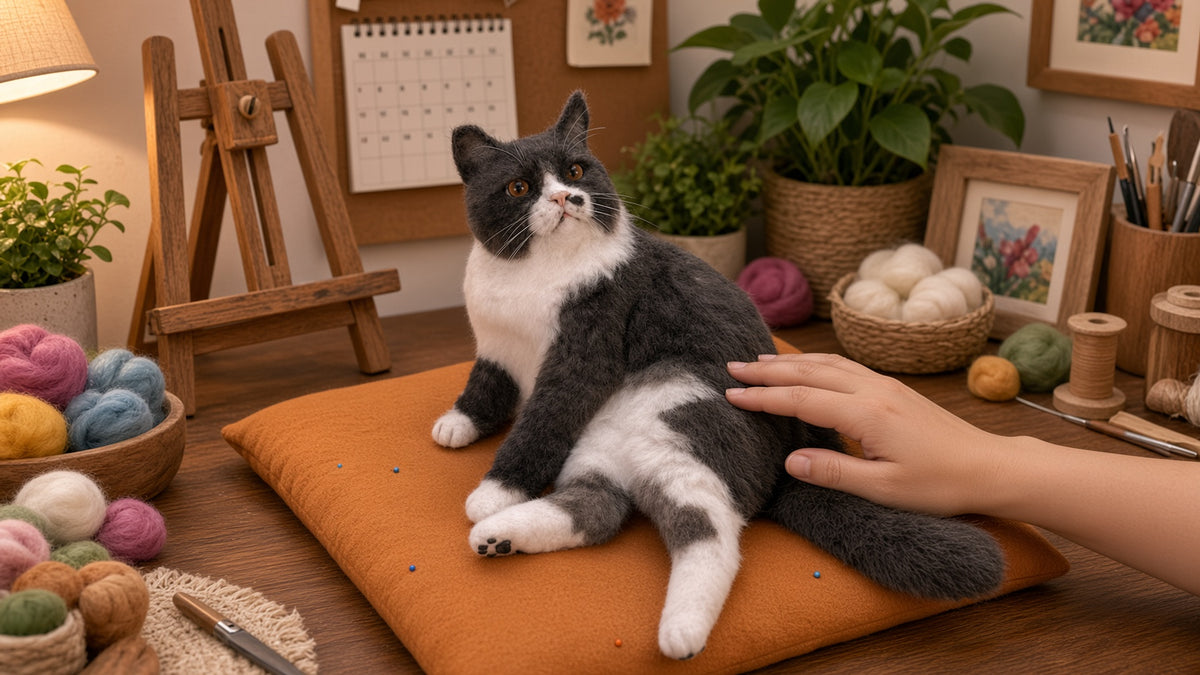
What is a needle felted pet portrait? It is a picture or small sculpture of a particular animal made by shaping fibres with specialised felting needles. Instead of applying colour to paper or printing a photograph, the maker builds form, colour and surface texture with fibre.
The phrase sounds precise, yet it covers several kinds of object. Some portraits are almost flat; others project from a backing or stand on their own. A front-facing product image can hide most of the depth, so look for a side view too. This page explains the craft vocabulary. For formats, pricing logic and how to commission at WYjade, hand off to the hub links below.

Start with the verb: felting
Needle felting uses specialised needles to entangle and compact fibres. The Smithsonian’s National Museum of African American History and Culture describes the technique as using special needles to fuse wool fibres. The Textile Museum of Canada teaches the same medium as a way to shape and attach wool into small sculptural forms.
Repeated needling makes a loose bundle denser and more stable. More fibres can be added for colour, markings and surface detail. The same basic action can produce a flat patch of felt, a raised muzzle on a framed piece or a complete small figure. A felt portrait is therefore built in fibre, not simply printed on fuzzy fabric.
Craft glossary (terms you will see in listings)
- Needle felting
- Compacting and shaping fibre by stabbing with barbed needles so filaments tangle into a stable form.
- Wet felting
- A different method that uses moisture, soap and friction to mat fibres. Custom pet portraits at WYjade are needle-felted, not wet-felted sheets.
- Relief (low / dimensional)
- How far the face or coat projects from a backing. Low-relief sits almost flat; dimensional relief lifts muzzle, ears or paws while remaining a display piece.
- Armature
- An internal support (wire or similar) sometimes used in freestanding figures. Not every portrait has one—ask if construction matters to you.
- Likeness
- How recognisably the finished piece reads as your animal. Handmade likeness interprets photos; it is not a mechanical clone or a guaranteed percentage score.
- Core wool / colour wool
- Bulk fibre that builds volume versus finer coloured fibres laid for markings, eyes and surface texture.
- Backing / mount
- The board, fabric or frame that holds flat or relief work. Freestanding sculptures may have no picture backing.
- Preview / revision stage
- The point in a commission when you can confirm priorities before the piece ships. Process details live on product pages and the order guide—not in the craft name alone.
“Portrait” describes the subject, not one standard shape
A portrait represents an individual pet rather than a generic breed. The reference set might show eye colour, ear position, a blaze down the face or an uneven pair of socks. The maker interprets those clues in fibre. The word portrait is not a promise of a mechanical copy.
The finished object may fall into one of three broad families:
- Flat or low-relief work
- Fibres sit on a backing much like a textile picture, with little projection from the surface.
- Dimensional relief
- The face, muzzle, paws or coat rise from a backing or frame, while the work remains a display piece.
- Freestanding sculpture
- The whole animal is interpreted as a small three-dimensional figure, so posture and body markings matter as well as the face.
Sellers may use these labels differently. Check photographs from the side as well as the front. For a deeper format comparison, see WYjade’s 2D versus 3D pet portrait guide—or go straight to the felt portraits hub if you are choosing what to order.
Follow one marking from photograph to fibre
Imagine a grey cat with a narrow cream line beside the nose. One photograph may show the line clearly but make the eyes look too dark. Another may catch the eye colour accurately while hiding part of the muzzle. A portrait maker needs to know which image leads for expression, which one leads for colour and which detail must not disappear.
In fibre, that cream line is not selected with a paint tool. It has to be placed, shaped and blended into the surrounding grey. Small asymmetries often do more work than a general breed description because they identify this animal rather than any grey cat.
Several clear photographs usually answer more questions than one polished image. WYjade’s reference-photo guide covers angles, light and markings.
What the term does not tell you
The name alone will not tell you finished size, amount of relief, whether the portrait includes the whole body, display method or making time. Nor does it confirm that an old, blurred photograph contains enough information. Cleaning advice depends on the particular object—see the separate needle felted pet portrait care guide.
Those gaps are normal product questions. Compare the live listing with the images you can supply, then use the hub and cost guide rather than inventing numbers from this definition page.
Read the object before you read the sales words
Look at the portrait from more than one angle. Is it a fibre picture, a raised face inside a frame or a complete figure? Can you see the sort of detail that matters for your pet? Once those questions are answered, the phrase becomes straightforward: a needle felted pet portrait is an individual animal interpreted in shaped fibre.
WYjade’s live felt pet portrait collection shows currently available formats. For the full overview of formats, photos and how commissions work, continue to the felt portraits hub; for pricing logic open the cost guide; when ready, follow how to order.
Frequently asked questions
Is needle felting the same as wet felting?
No. Needle felting shapes fibre with barbed needles; wet felting mats fibre with moisture and friction. Custom WYjade pet portraits use needle felting.
Does “needle felted pet portrait” mean 2D or 3D?
Either. The phrase names the craft and subject, not one depth. Check side photos and listed dimensions, or read the 2D vs 3D guide.
How close will it look to my pet?
Makers aim for recognisable likeness from your photos—not a percentage-perfect clone. Clear daylight images of eyes and markings help most.
Where should I go next if I want to commission one?
Start with the felt portraits hub, skim the cost guide, then follow how to order a custom felt pet portrait.
Is this page a price list?
No. This article defines the craft. Live prices and sizes sit on product pages and in the cost guide—do not invent numbers from the definition alone.