October 10, 2026
Pet Memorial Plaque Wording: Short Lines That Fit
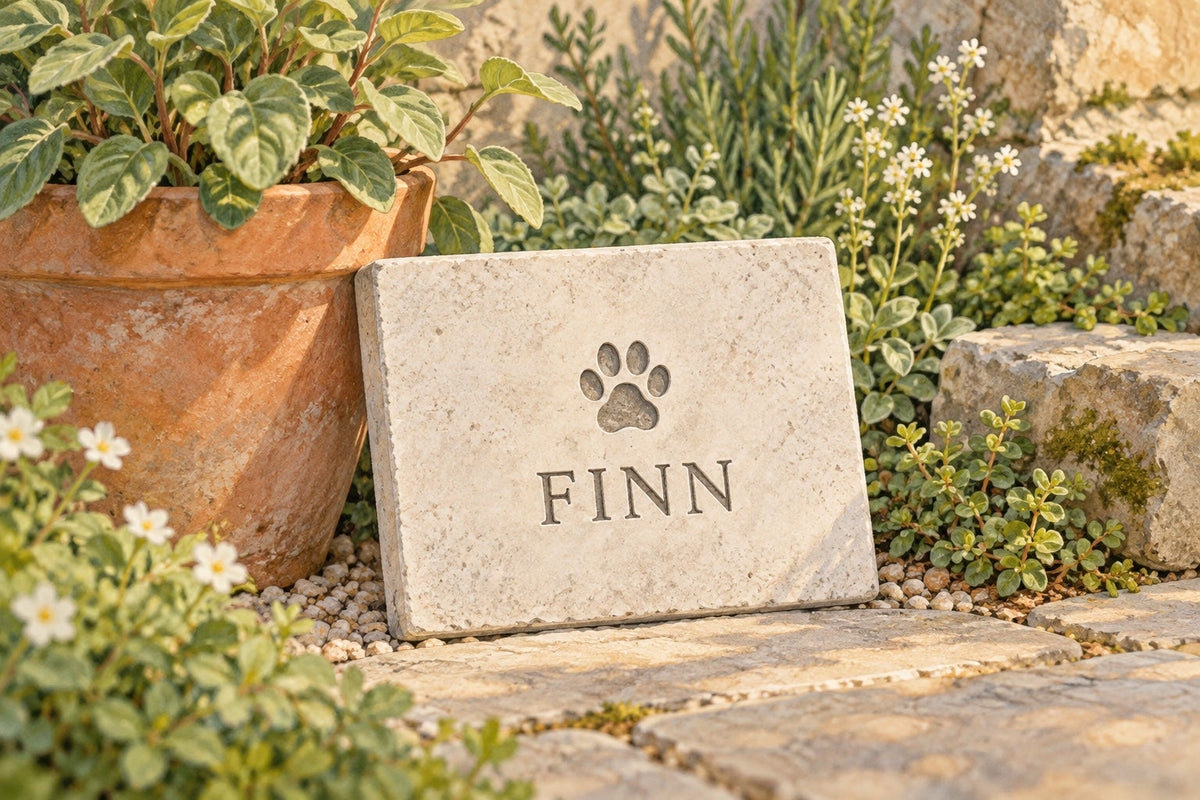
Pet memorial plaque wording can be as simple as a name and one short line you would be happy to read again. Dates are optional. Before settling on a sentence, check how much text the chosen plaque can hold.
You may want a plain inscription, a familiar household phrase or a small joke. There is no need to make a plaque sound more formal than the pet’s life was. Here are some ways to put a first version on paper.
Short pet memorial plaque sayings to adapt
The names and dates below are illustrative. Replace them with your own details, and keep only wording you would actually use. The line breaks show possible arrangements, not a promise that the text will fit every plaque.
A simple remembrance
Remembering Finn
2012–2026
Our much-loved friend
This is useful when you want the name and years to do most of the work. A familiar phrase is fine if it feels right; you do not have to invent something unusual.
For a dog, without dates
Tess
Always first to the gate
Choose a line that recalls your dog rather than any dog. A gate, a favourite path or a place beside the sofa may suggest the words. Leave out a habit that did not belong to them.
For a cat
Olive
Keeper of the sunny chair
If your cat claimed a windowsill or laundry basket instead, use that. Keep the place you remember, even if it seems unremarkable to someone else.
For a pet whose birthday was unknown
Moss
With us, 2018–2026
Loved every walk
“With us” tells readers what the years mean. Use the dates the pet lived with you only if you know them. You can remove the years entirely and keep the name and final line.
For a smaller companion
Pip
Small paws, much-loved company
This could suit a rabbit or another small pet, but the wording should still match the animal. Replace “paws” if it is wrong for your companion. A bird’s call or a rabbit’s evening routine may lead to a more particular line.
When a little humour belongs
Bert
Chief biscuit inspector
Use this sort of line only if it sounds like something the household would say. For a gift, check the wording with the recipient before ordering. A joke that suited your relationship with the pet may feel wrong to them.
Turn a remembered habit into a short inscription
Start with a full sentence, even if it is much too long to engrave. For example: “Milo waited beside the back door every morning until someone picked up his lead, then walked the same lane with us.” That invented memory gives you something specific to edit.
“Our walking companion” keeps the shared activity. “Waiting by the back door” keeps the place and habit. They are different choices, and neither needs the rest of the story underneath. If you are deciding what to write on a pet memorial plaque, try both on separate sheets and see which you recognise more readily.
Keep a copy of the longer memory while you edit. If a shorter version loses the part you care about, return to that draft. You may also decide on “our lovely boy” because that was what you always called him. Familiar words do not need improving for the sake of an inscription.
For a stone marker, use the same exercise. Its shape and engraving area will affect the line breaks, so leave the layout open until you have chosen the object.

Dates do not have to tell a complete life story
Check names and dates against your own records. Do not give an adopted pet an invented birth year to make the inscription look complete. An adoption year should not silently stand in for a birth year. Label it, use a phrase such as “With us”, or omit dates.
A name alone is also possible. If several people share the memorial, agree whether to use the everyday name or a longer registered name. A nickname that needs explaining to visitors may still be right for a private keepsake.
Think about who will read the words. A religious phrase can belong on your own memorial if it expresses your beliefs. For a gift, let the recipient choose that language. Write a separate note to them rather than making the plaque carry condolences; our guide to what to write in a pet sympathy card covers that task.
A word count is not an engraving limit
A short sentence can still be too long for one line. PlaqueMaker’s wording guide suggests about 20–30 words as a starting point and notes that longer text can require a larger plaque or smaller lettering. That is writing guidance, not a universal allowance.
Limits can be much tighter. For example, the order fields on Memorials.com’s White Marble Name Plaque specify 18 characters per line, including spaces. That limit belongs to that particular item. Read the fields for the plaque you are considering rather than borrowing a number from another design.
“Our walking companion” has 21 characters including spaces. “Walking with us” has 15. Under an 18-character line limit, the second fits the count; the first does not. Passing the count still does not establish how large or readable the engraving will be.
Ask whether spaces, punctuation and symbols count, how many lines are available, and whether an image reduces the text area. Check how accented letters and any special characters will appear. Copying a line from a website does not confirm that the maker can reproduce every character.
Give the maker an unambiguous final version
Use separate lines in your final text file. Ask for a proof showing the layout, and find out whether you can review it before production. Do not assume that an on-screen text box is the final engraved arrangement.
Read the proof once without your draft beside it. Does the line break change the meaning? Is the name easy to pick out? Then compare it with the draft, checking the name letter by letter, each date and the punctuation. Another reader may spot something you have stopped noticing.
Look at the intended size, not just a zoomed-in screen image. Ask the maker to confirm the text area and lettering size if they are unclear. If the message looks crowded, remove words before asking for smaller lettering. A paper copy at the proposed dimensions can help you judge the layout, but it cannot prove the finished engraving’s contrast or weather resistance.
Location is a separate decision. Our pet memorial garden ideas cover planning the outdoor space. If you would rather keep a likeness indoors, pet memorial portrait ideas explore that choice. Neither needs to be squeezed into the inscription.
Once the wording is agreed, save the exact proof you approve, with its date. If you send a later correction, ask for that correction to appear in a new proof before you approve it. Keep the earlier versions separate so there is no doubt about which one is approved.